On this page
South Korea's grocery market is served by hypermarkets, neighborhood supermarkets, cooperative stores, warehouse clubs, convenience stores, department-store food halls, and online platforms. These formats have different owners, missions, product ranges, and buying routes, so a useful market map separates them instead of ranking every banner in one list.
The operator details below were checked against company and public-sector sources available in September 2026. Store networks change, and Homeplus is restructuring, so suppliers should verify the current buyer and active-store scope before presenting a launch plan.
South Korea's grocery channel map
The USDA Foreign Agricultural Service's Korea Retail Foods Annual, published on November 19, 2025, separates hypermarkets, grocery supermarkets, convenience stores, department stores, specialty retailers, and online retailers. That distinction matters for pack size, price architecture, service frequency, and promotions.
A 2025 Flanders Investment & Trade market note reports that independent stores still account for a large share of supermarket sales. National banners are visible entry points, but they are not the whole grocery market.
Types of grocery store in South Korea
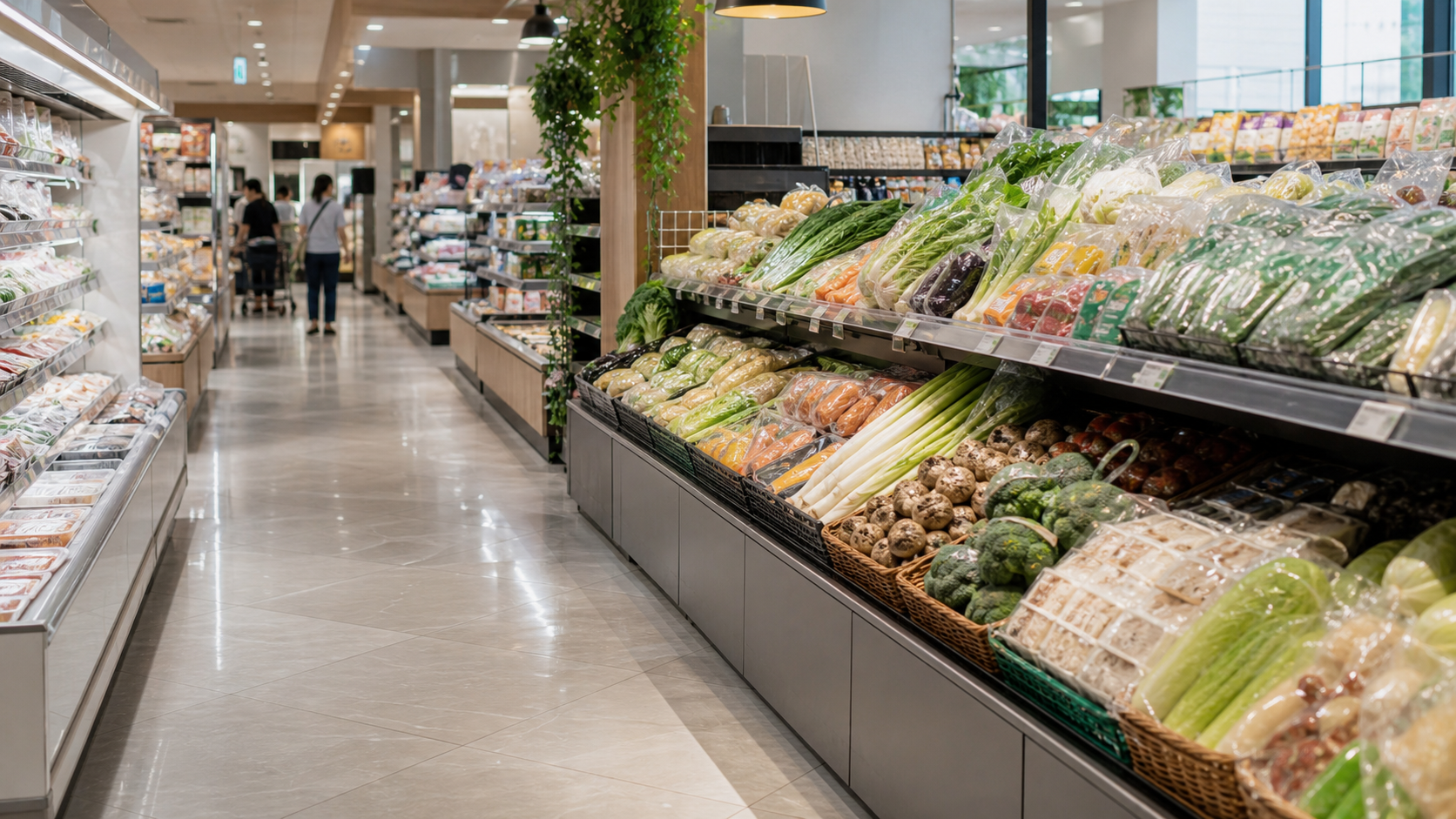
- Hypermarkets and discount stores: large one-stop stores led by Emart, Lotte Mart, and Homeplus.
- Neighborhood supermarkets: smaller grocery-led formats including GS The Fresh, Lotte Super, Emart Everyday, Homeplus Express, Hanaro Mart locations, and independents.
- Warehouse clubs: membership or bulk-buy formats such as Costco Korea and Emart Traders.
- Convenience stores: high-density small-box networks such as CU, GS25, 7-Eleven, and Emart24.
- Online grocery: marketplaces and delivery platforms including Coupang, Kurly, and SSG.com.
- Premium and specialist retail: department-store food halls, organic banners, imported-food shops, and category specialists.
Large-format grocery operators
Emart
Emart Inc. operates the Emart discount-store banner and Emart Traders warehouse format. Its official business structure also identifies online and supermarket activities. Suppliers should specify which format they are targeting because a standard Emart listing, a Traders bulk pack, and an online offer use different pack and pricing logic.
Lotte Mart
Lotte Shopping operates Lotte Mart as a grocery-focused discount-store business. Lotte's company profile reported 111 Korean Lotte Mart stores and 64 overseas stores for 2023; the 2025 Lotte profile reports 175 stores at home and abroad without presenting that total as Korea-only. Its specialist formats include Zettaplex, MAXX, Bottle Bunker, and other concepts. Verify the relevant Korean banner and buyer rather than using a global store total in a sales case.
Homeplus
Homeplus operates large-format stores and the Homeplus Express neighborhood banner, but its network is in active restructuring. The company entered rehabilitation proceedings in March 2025. On September 2, 2026, a Seoul court approved a plan centered on profitable stores and selected store sales, according to SBS News. Treat the active network, buying authority, payment terms, and rollout assumptions as date-sensitive facts.
Costco Korea and Emart Traders
Costco Korea and Emart Traders serve the warehouse-club mission. Larger packs, member value, efficient cases, and dependable supply matter more here than a conventional supermarket range. Costco is a separate international retailer; Traders is part of Emart's format portfolio.
Neighborhood supermarket operators
Nonghyup Hanaro Mart
Hanaro Mart is associated with the National Agricultural Cooperative Federation and regional cooperatives. Its role in domestic agricultural products makes it structurally different from a centrally controlled private chain. The USDA retail report lists Nonghyup Hanaro Mart among leading offline grocery-supermarket operators. Suppliers should establish whether purchasing is central, regional, or store-level for the target product.
GS The Fresh
GS Retail operates GS The Fresh as its supermarket banner. The company's official history records that the network passed 500 stores in July 2024. GS The Fresh is distinct from GS25 convenience stores even though both sit within GS Retail.
Lotte Super, Emart Everyday, and Homeplus Express
These banners target more local, frequent grocery missions than their groups' large-format stores. Smaller footprints affect pack size, assortment depth, replenishment, and shelf productivity. Homeplus Express is also exposed to the wider Homeplus restructuring, so confirm current ownership and buying responsibility before outreach.
Convenience stores are a separate channel
CU, GS25, 7-Eleven, and Emart24 sell food and beverages, but they are convenience operators rather than supermarket chains. They emphasize immediate consumption, ready-to-eat products, single serves, limited shelf space, and frequent new-product cycles. Route proposals should address convenience-specific packaging, merchandising, delivery, and promotional economics.
Online grocery and marketplaces
Coupang, Kurly, and SSG.com are major online discovery and purchase routes. They are not interchangeable with a distributor. A brand still needs to establish who imports the product, owns inventory, fulfills orders, funds promotions, manages returns, and holds customer data. Marketplace availability can complement an offline launch or serve as a focused test, depending on the category.
How to prioritize a retail buyer
Choose the format before the banner. Compare each route against the product's target shopper, occasion, shelf life, pack, temperature, intended price, launch budget, and replenishment needs. Then identify the correct buyer and determine whether the retailer imports directly or expects supply through a Korean importer or vendor.
For partner roles and route qualification, use our South Korea distributor selection guide. For named importer and foodservice candidates, review the South Korea distributor shortlist.
Frequently asked questions
What are South Korea's main grocery formats?
The market includes hypermarkets, neighborhood supermarkets, cooperative stores, warehouse clubs, convenience stores, department-store food halls, specialist retailers, traditional markets, and online grocery platforms.
Which companies operate large-format grocery stores?
Emart Inc., Lotte Shopping, and Homeplus are the best-known domestic large-format operators, while Costco Korea operates a membership warehouse network. Homeplus remains active but is restructuring under a court-approved rehabilitation plan as of September 2026.
What is the best retail entry route for an imported brand?
The answer depends on shopper, category, price, pack, shelf life, temperature, and launch resources. Premium food halls can suit discovery and higher price points; hypermarkets can require scale and promotion; neighborhood formats favor efficient ranges; convenience needs channel-specific products; and online can support targeted testing.
Plan a South Korea retail entry
GourmetPro's market entry service helps food and beverage brands choose priority channels, validate buyer and consumer fit, and build an executable route-to-market plan. When the plan requires an importer or distributor, the distributor partner search can identify and qualify suitable candidates.