
On this page
Germany's confectionery opportunity depends on the product category, buyer and price point. Industry production, imports and retail spending measure different things. This guide uses German industry and statistical sources to explain category scale, then turns that evidence into decisions about the range, pack, buying route and launch requirements.
The figures below describe 2025 production and selected developments available on 16 September 2026. They are not a forecast of consumer spending. Once the category proposition is clear, use Germany market-entry planning to connect it to the importer, customer and delivery responsibilities.
Overview of the Confectionery Market in Germany
The German confectionery association BDSI reports 4.168 million tonnes of production worth €19.071 billion in 2025: volume fell 3.7% from 2024 while nominal production value rose 11.5%. Its industry perimeter includes chocolate, sugar confectionery, fine bakery, savoury snacks, ice cream, cocoa/chocolate semi-finished goods and raw pastes. It excludes cocoa-containing food preparations. This is a broad manufacturing measure, not German shoppers' expenditure on sweets. BDSI production table.
| Scope | Volume | Production value | Change from 2024 |
|---|---|---|---|
| Broad BDSI confectionery industry | 4.168 million tonnes | €19.071 billion | Volume −3.7%; value +11.5% |
| Chocolate and chocolate products, including white chocolate | 1,102,800 tonnes | €8,373.2 million | Volume −5.8%; value +14.0% |
| Sugar confectionery | 652,900 tonnes | €2,247.7 million | Volume +0.1%; value +1.1% |
Sources: BDSI's chocolate production and sugar-confectionery production tables. These categories sit within the broad total; do not add them to it. Rising nominal value alongside falling tonnage does not establish stronger consumer demand or a successful premium strategy.
Germany is also a producer and trading location. BDSI's separate import and export tables include cocoa-containing food preparations, unlike the production total above. Their totals therefore cannot be combined with it to calculate domestic consumption or an export share. For a sales plan, request category-specific retail evidence for the intended channel.
Breakdown of the Confectionery Market in Germany
1. Chocolate Confectionery
Separate everyday bars, filled products and seasonal figures in the buyer brief. They can need different pack sizes, shelf positions and order calendars. BDSI's chocolate output fell in volume in 2025; the higher production value is a reason to examine price and cost assumptions, not to assume that every premium offer is growing. Compare products by weight, cocoa content, filling, pack and intended occasion before treating their shelf prices as benchmarks.
2. Sugar Confectionery
Gummies, jellies, boiled sweets and other sugar products have different formulation and eating characteristics. Within the 2025 sugar-confectionery table, BDSI reports 390,400 tonnes of gums and jellies, up 1.1%. That production class does not reveal vegan sales or shopper preferences. For a gummy proposal, specify the gelling system, texture, flavour, portion and ingredient claims, then test it against the target buyer's range.
3. Ice Cream
Ice cream appears in the broad BDSI industry perimeter, but its frozen storage and delivery requirements make it a separate commercial proposal from an ambient chocolate bar. Establish the required delivery temperature, case configuration, receiving arrangements and freezer location with the buyer. An ambient confectionery distributor should not be assumed to provide frozen handling.
4. Preserved Pastry Goods and Cakes
The fine-bakery category also belongs to the broader industry picture. For biscuits, cakes or a seasonal bakery line, make the delivery shelf life, breakage protection and pack format explicit. A long-life wrapped product and a fresh bakery offer need different stock and replenishment assumptions; choose the relevant buyer and route before comparing their economics.
Price, volume and seasonal planning
Cocoa costs need a date and a measure. Destatis reported that German raw cocoa import prices in July 2026 were 32.6% below July 2025 but 9.7% above June 2026. That is an import-price index, not a spot quotation, a finished chocolate price or the cost paid under every manufacturer's contract. Destatis, released 28 August 2026.
Build the quote from the actual recipe, contracted inputs, pack and delivery route. Compare the proposed shelf price per 100g or kilogram, then model the contribution left after freight, distributor and retailer terms, promotions and expected waste. Test a base case and a higher-input-cost case. A smaller pack changes the cash price and consumption occasion; it should not conceal a weak unit-margin calculation.
Seasonal figures provide a concrete example of a different production cycle. A BDSI member survey counted about 146 million chocolate Santa and Nikolaus figures produced for Christmas 2025, 11% fewer than in 2024. The survey includes products for export, so it is not German Christmas sell-through. BDSI seasonal survey.
For a seasonal line, work back from the buyer's delivery window through artwork, tooling, trial production and shelf-life evidence. Agree who carries unsold stock and whether the pack can sell after the event. The useful question is how much the buyer will commit to, not whether a national celebration exists.
Product examples and propositions to test
These company examples show available product approaches. They are not a ranking of Germany's brands or evidence of a category-wide growth rate.
| Example | What the company offers | Question for your proposal |
|---|---|---|
| Ritter Sport vegan range | A specifically identified vegan confectionery range. | Does the product meet the intended texture, taste, allergen and shelf-price benchmark? |
| ChoViva | A cocoa-free alternative based on ground sunflower seeds; the company describes milk-containing and vegan formulations. | Which formulation and legal description fit the finished product? Do not call every version vegan or sell a cocoa-free alternative as ordinary chocolate. |
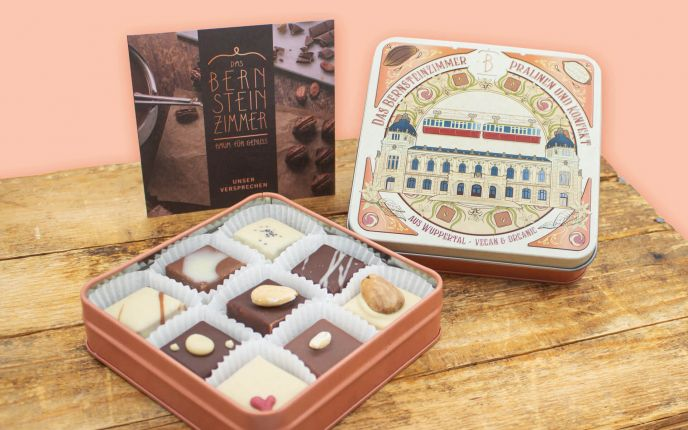
| Das Bernsteinzimmer | Organic vegan pralines and chocolate. | Can the proposed assortment, presentation and delivery shelf life support a specialist or gifting proposition? |
Use a tasting and price comparison to assess a proposed flavour, vegan recipe or premium pack. Record the competing SKU, retailer, pack weight and date. A product's availability proves that an offer exists; repeat orders, buyer feedback and a viable margin are the evidence needed for your own launch decision.
For reduced-sugar or fortified confectionery, validate the formulation and intended statements before designing the pack. The EU nutrition and health claims framework imposes conditions on claims. Adding a vitamin or changing a gelling agent does not establish permission to advertise a health benefit.
Retail channels and buying levels
Start with the exact customer proposition: an everyday branded bar, a retailer-owned gummy range, a seasonal gift box and a frozen dessert need different buyer discussions. Use the Germany supermarket groups and buying-structures guide to distinguish EDEKA's cooperative levels, REWE and PENNY, Lidl and Kaufland, and the separate ALDI businesses. A parent-group name does not identify the buyer for every format or region.
| Proposed route | Prepare for the buyer | Resolve before committing |
|---|---|---|
| Branded grocery range | Category role, benchmark pack and price, consumer proposition and supply plan. | Buying level, trial scope, replenishment expectations and promotional costs. |
| Retailer-owned range | Manufacturing specification, sensory benchmark, audit evidence, capacity and cost options. | Who owns the recipe/artwork, forecast assumptions and stock at delisting. |
| Specialist or gifting offer | Assortment, provenance evidence, presentation, shelf life and case economics. | Account coverage, seasonal order windows and unsold-stock exposure. |
| Online sales test | Delivered basket economics, transit protection, product information and service plan. | Acquisition cost, repeat purchase, damage and returns; online availability alone is not demand. |
These are planning choices, not measured channel shares. Qualify an intermediary by the customers it actually serves, its handling capability and the functions it accepts. Keep import responsibility, warehousing, sales representation and credit exposure explicit.
Sourcing, labels and packaging
Prepare German mandatory information under LMIDV section 2, including the applicable ingredient, allergen and nutrition information under the EU food-information framework. Product composition, claims and origin determine which additional checks matter. A buyer's artwork approval does not replace the legal assessment.
Cocoa sourcing also needs a documentary plan. The Commission's July 2026 EUDR update confirms that cocoa and specified derived products fall within its framework. It gives 30 December 2026 as the application date for large and medium operators and the specified small/micro operators already covered by timber rules, and 30 June 2027 for other small/micro operators. Check the actual product code, business role and applicable date; a sustainability logo is not a substitute for the required sourcing records.
For packaging, identify the responsible party for the actual branded or retailer-owned arrangement using ZSVR's own-brand and import guidance. Check registration and any required system participation separately: the LUCID register excerpt does not itself prove a recycling-system agreement. Confirm material weights and reporting handoffs before dispatch.
First buyer test and launch plan
A useful first test has a named category, banner or account group, pack, price and supply route. Set out what would justify a repeat order: the customer's requested evidence, acceptable delivery shelf life, service performance and margin after launch costs. Keep seasonal stock exposure separate from an everyday replenishment forecast.
- Choose one category and buying route using comparable store and product observations.
- Prepare the specification, samples, source records, German artwork and delivered-price model.
- Agree trial quantities, decision dates, production slots and the owner of each unresolved requirement.
- Review actual buyer response and delivery economics before expanding the range or territory.
FAQs
1. How big is the confectionery market in Germany?
BDSI's broad German industry-production measure was 4.168 million tonnes and €19.071 billion in 2025. It includes more than chocolate and sugar sweets and is not a consumer-retail market value. For a sales decision, match retail evidence to the exact category, channel and period.
2. What are 3 key trends in the confectionery market in Germany?
Three useful issues to assess are price/volume divergence, the planning needs of seasonal ranges, and differentiation through recipes or packs. The first two have dated German production and price evidence above. Vegan, cocoa-free and specialist examples show possible propositions, but do not establish a universal growth forecast.
3. Which are the top 3 brands in the confectionery market in Germany?
The sources used here do not establish a comparable current top-three retail brand ranking. Chocolate, sugar confectionery and ice cream need different competitive sets. Benchmark brands within your proposed category and channel, using a stated sales measure and period rather than mixing brand names with their parent companies.
Ready to expand your confectionery brand in Germany?
Bring one product specification, target buyer group and delivered-price model to a Germany market-entry scoping discussion. Define whether the next decision concerns category demand, product readiness, partner selection or a buyer test, then agree the evidence and work needed.
References
- BDSI: German confectionery industry production, 2025
- BDSI: German chocolate and chocolate-product production, 2025
- BDSI: German sugar-confectionery production, 2025
- BDSI: German confectionery imports, 2025 (includes food preparations)
- BDSI: German confectionery exports, 2025 (includes food preparations)
- Destatis: July 2026 import-price indices, released 28 August 2026
- BDSI: Christmas chocolate-figure production survey, December 2025
- Ritter Sport: vegan product range
- ChoViva: sunflower-seed formulations and ingredients
- Das Bernsteinzimmer: organic vegan pralines and chocolate
- European Commission: nutrition and health claims framework
- German LMIDV section 2: language of mandatory food information
- European Commission: food information to consumers
- European Commission: EUDR scope and application-date update, July 2026
- ZSVR: packaging responsibilities for own brands and imports
- ZSVR: checking registration and system-participation evidence

![A Deep Dive into the India Confectionery Market [2025]](https://pub-57436e8345ca4215942d537b44590491.r2.dev/675570f7c96c030d90d8a465_images-for-blogs-10_9fcef9d897e4ce3ed226d454bca8e7ba_2000.jpeg)


