
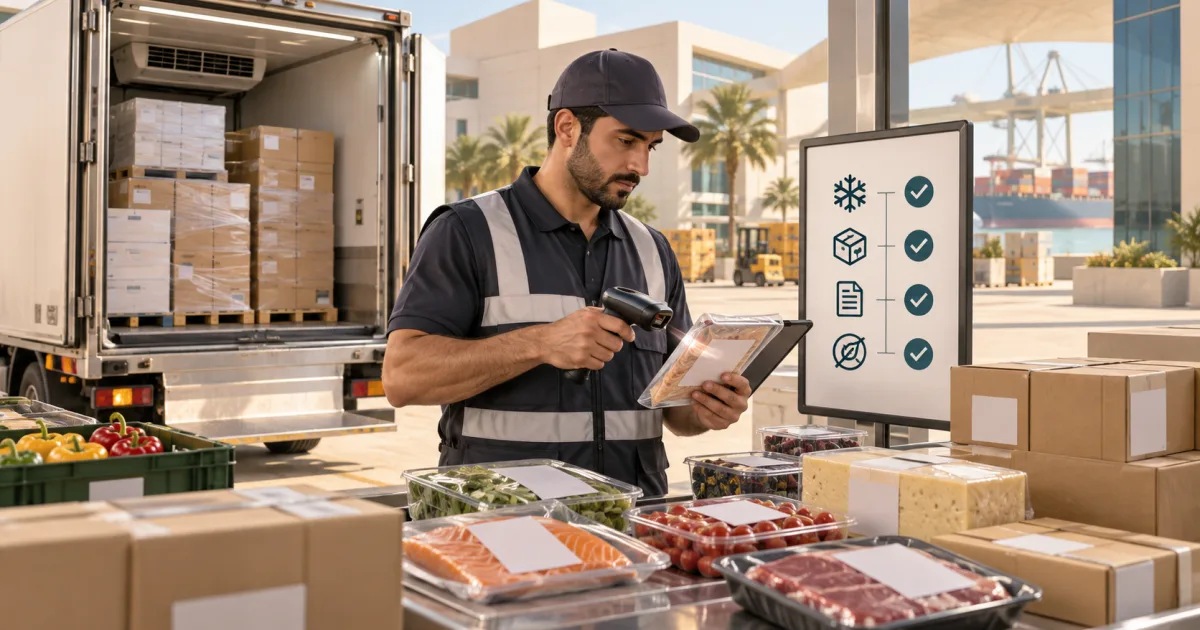
UAE Market Entry for F&B Brands: Country Hub
The UAE is an import-dependent, premium food market, and demand for foreign F&B brands is strong. What separates the brands that land from the ones that stall is readiness, not appetite: halal and import clearance, the right importer, and a price built for local shelves. This hub sets the scope, budget bands, and gates so you can self-qualify before you spend.


.webp)



.avif)

.webp)
.avif)


.avif)








The UAE imports the overwhelming majority of its food, which makes it unusually open to foreign brands, and unusually crowded. Getting onto a Dubai or Abu Dhabi shelf is less about demand than about clearing the gates in the right order: food-safety and import approval, category-specific halal and health documentation, and an importer who actually handles your category. This hub maps that sequence so a prepared brand can move fast and an unprepared one can see the gap before spending.
The most common reason a UAE entry stalls is not a competitor winning the deal; it is a fit or readiness gap that was knowable up front. This page is built to surface those gaps early, so you commit to the market only when the pieces are in place.
Is UAE Market Entry Right for You Right Now?
Start with fit, because it is the section most likely to save you money. Most UAE entries that fail do so for reasons visible before the first call: the product was not export-ready, no one owned the halal or import track, or the budget did not match the scope of work expected. None of these is a market problem, and all of them are cheaper to catch here than on a paid engagement.
What a UAE engagement actually covers
A realistic UAE market-entry engagement covers three workstreams, mapped to the three channels below:
- Compliance review: confirming your product clears UAE food-safety, import, labeling, and halal gates before samples ship (UAE Government food-safety guidance; MOIAT halal program).
- Distributor and importer sourcing: the commercial core, and consistently the hardest part of UAE entry. The UAE runs on the importer relationship, and the work is matching the importer to your category, channel, temperature zone, and buyer type, not signing the biggest name.
- Positioning and price localization: shelf and pricing strategy for a market where premium imports and sharp price sensitivity sit side by side.
What budget band should you expect?
There is no fixed UAE price list, because scope drives cost. Use these bands as planning ranges to self-select, not a quote or guaranteed price:
- Under USD 5k: narrow desk validation only; not enough for real distributor sourcing.
- USD 5k to 20k: focused market validation, a channel map, a compliance review, or a targeted importer longlist.
- USD 20k to 50k: deeper entry strategy, distributor shortlisting, and launch sequencing.
- USD 50k+: execution-heavy or multi-market work connecting the UAE plan to a wider GCC/MENA expansion.
That candor matters. A common and avoidable mistake is wanting the full engagement on a fraction of the budget. If your budget sits below the work you expect, fix that before booking a call.
When should you not hire an advisor yet?
Skip the call for now if any of these describe you:
- No halal or import owner, and no plan to get one. For meat, poultry, products subject to halal controls, and halal claims, confirm the applicable certification and recognized certifier scope (MOIAT halal program); an advisor can diagnose that gap but not compress it.
- No export-ready SKU. If the product is not yet built or certified for export, advisory surfaces the gap but cannot close it for you.
- No budget line for a distributor relationship. The UAE runs on the importer relationship; with no money to build one, advisory solves the wrong bottleneck.
The same applies if you expect a national retail listing before category validation: a UAE importer can open doors, but the product still needs a channel-specific price, label, margin story, and support plan. The fastest way to waste a UAE budget is to enter half-prepared, and it is cheaper to learn that here than on a sales call.
How Should You Choose Between Modern Retail, Traditional Trade, and Foodservice?
The channel choice determines the partner you need. Modern retail, traditional trade, and foodservice share the same federal compliance gate, but not the same economics or launch motion. The regulatory column below is sourced to UAE authorities; the channels diverge on who you sell through and how fast you reach shelf, not on compliance.
| Channel | Who you sell through | Regulatory & halal gate | Best-fit brand | Typical entry motion |
|---|---|---|---|---|
| Modern retail (hypermarkets, online grocery) | Licensed UAE importer → hypermarket category buyer | Food-safety and first-time-import approval plus ZAD product registration, with halal review according to product category and claims (UAE Government; MOIAT) | Premium imported packaged F&B landing first at scale | Slower listing cycle; importer negotiates the category slot and launch support |
| Traditional trade (souks, independent grocers, wholesale) | Wholesaler and distributor networks | Same federal import-and-registration gate; category-specific halal requirements | Value and staple ranges, high-volume SKUs | Faster to shelf via wholesalers; lower margin, higher volume |
| Foodservice / HORECA (hotels, restaurants, catering) | Foodservice distributor or HORECA specialist | Same import path, with venue-grade documentation; halal effectively table stakes in most venues | Ingredients, bulk formats, chef-facing brands | Relationship-led; venue documentation and halal effectively required |
The read: the regulatory gate is common to all three (food-safety approval, ZAD registration, and category-specific halal requirements), so compliance is not where the channels diverge. They diverge on who you sell through and which product format fits. Pick the channel where your product is already strongest, win there, then extend; spreading one launch budget across all three is a common way to land nowhere.
The UAE Market-Entry Playbook
Five steps take a brand from interest to shelf. Run them in order, because each de-risks the next.
- Registration and halal/import compliance. Start with the product, not the buyer list. Any food entering the UAE for the first time needs approval from the Ministry of Climate Change and Environment and registration in the ZAD electronic system before it reaches the market, and halal certification requirements must be checked for the actual product category and claims (UAE Government food-safety guidance; MOIAT halal program). Get this track wrong and product is held at the port, so start it first.
- Distributor and importer selection. Import registration is lodged by a licensed local importer, so your distributor is both a commercial partner and the entity that clears your product. The right question is not "who is biggest?" but "who handles this category, channel, temperature zone, and buyer set?" Start with top food distributors in Dubai and leading UAE food distributors, then qualify fit.
- Shelf positioning in hypermarkets. Modern retail requires a category story, not just a product sheet: where the product sits, what it replaces, how it earns its shelf space, and what launch support the importer provides. A translated home-market pitch rarely clears the buyer's bar.
- Online channel strategy. Online grocery and quick-commerce reward different formats than a hypermarket end-cap. Decide whether your SKU is a basket-builder, a trial SKU, or a hero item before negotiating pack size and promotion, because that choice shapes price localization.
- Price localization. Price localization is where many UAE launches quietly fail, because brands apply a home-market margin model to a channel that does not support it. Build the price from UAE shelf reality backward.
What Does a UAE Market-Entry Advisor Actually Do?
A UAE advisor compresses the steps above (compliance path, importer fit, channel prioritization, price localization, and launch sequencing) and flags the friction that sinks launches: halal lead times, Arabic-labeling requirements, and the price sensitivity that catches premium brands off guard. The useful advisor tells you what not to do as early as what to do.
GourmetPro's MENA advisory draws on Dave Ong, a Singapore-based APAC/MENA strategic advisor with 18+ years in F&B commercial and market-entry roles, whose Middle East work includes onboarding master franchisees for Dubai-based Bateel (per his GourmetPro expert profile).
Top UAE food distributors
Getting matched to the right importer is the highest-leverage step in a UAE entry. GourmetPro keeps the named distributor list in two commercial-intent guides rather than duplicating it here:
- top food distributors in Dubai: Dubai-specific importer and distributor mapping.
- leading UAE food distributors: the wider national distributor landscape.
- UAE retail landscape: the supermarket and hypermarket channel context.
If you are close to a decision, these distributor guides are the most useful next click, because importer fit is the choice that most shapes how a UAE entry goes.
Which GCC Market Should You Enter First: UAE, Saudi Arabia, or Qatar?
If you are weighing the UAE, the real question is usually which Gulf market to enter first, and Saudi Arabia and Qatar are the realistic alternative set. All three sit under a shared GCC standards backbone, all three require Arabic labeling, and halal requirements need checking against each destination and product category, so the compliance shape rubs off from one to the next. Where they diverge is scale and how heavy the registration lift is: Saudi Arabia is the region's largest food market, the UAE is the premium import hub most brands use as a beachhead, and Qatar is the smallest but among the highest-income. The table below sets the UAE against those two peers so you can see where each lands before you commit a budget.
| Market | Food market size (annual) | Regulatory regime | Labeling requirement | Typical entry timeline | Halal certification |
|---|---|---|---|---|---|
| UAE | $16.2B in consumer-oriented agricultural imports (2024, USDA FAS Exporter Guide Annual) | Federal: Ministry of Climate Change and Environment approval plus ZAD product registration | Arabic, or bilingual Arabic/English, mandatory | Importer-led; first-time import approval plus ZAD registration | Check category-specific halal requirements and the certifier’s current MOIAT recognition and scope |
| Saudi Arabia | Over $50B food retail market (2024, USDA FAS Retail Foods Annual); the largest of the three | National: Saudi Food and Drug Authority (SFDA) registration of both importer and each product via the Ghad platform | Arabic, or an Arabic translation on the label, mandatory | Registration-gated; SFDA importer and product registration before shipment | Mandatory for all meat, poultry, and animal-origin ingredients, from an SFDA Halal Center-designated body |
| Qatar | One of the GCC's smallest but highest-income food markets; imports the vast majority of its food | National: Ministry of Public Health (MOPH) Port Health and Food Control registration | Arabic, or Arabic/English bilingual, mandatory | Importer-led product registration through MOPH | Halal slaughter certificate for meat plus a halal certificate for any animal-origin ingredient, from an approved Islamic centre |
The takeaway: the UAE lands as the lightest and fastest GCC beachhead, which is why many brands prove the product there before extending. Saudi Arabia is the prize on size, but its SFDA importer-and-product registration is the heaviest lift of the three, so treat it as the market you graduate into rather than the one you test in. Qatar is a focused, high-income follow-on that shares the UAE's halal and Arabic-labeling gates, so a compliant UAE launch carries most of the way there.
Frequently Asked Questions
How long does UAE food import approval take?
Timelines vary by product, so treat any single number with caution. Any first-time import needs approval from the Ministry of Climate Change and Environment and ZAD registration before it reaches the market (UAE Government). The real timeline depends on category, label status, halal requirements, and importer readiness, and is best scoped in a market-entry review rather than guessed.
What are halal certification requirements for new entrants?
Halal requirements depend on the product category and claims. For products subject to halal controls, check certification from a MOIAT-registered body with the appropriate scope (MOIAT halal program). Start with your certifier's UAE recognition status and the product's full ingredient chain; an unrecognized certifier can mean rejection at the port. For a broader exporter view, read Halal Meat Certification for F&B Exporters.
How much does market-entry advisory cost in the UAE?
Use the bands above as planning ranges, not a quote: under USD 5k is usually desk validation; USD 5k to 20k a focused review or targeted longlist; USD 20k to 50k deeper distributor and launch sequencing; USD 50k+ execution-heavy or multi-market work. The most common budgeting mistake is expecting the full engagement on a fraction of the budget, so match your budget to the scope you actually need.
Do I need a local distributor before I register a product in the UAE?
In practice, select the importer and compliance route together. Import registration is lodged by a licensed UAE importer, so the distributor relationship and compliance path are linked: your importer typically registers and clears your product (UAE Government). Treat distributor selection as part of compliance planning, not a later sales task.
Which UAE retail channel is best for new F&B brands?
There is no single best channel; it is category-specific. Modern retail suits packaged premium products, traditional trade suits value and breadth, and foodservice suits ingredients and bulk formats. The table above frames the trade-offs so you can match the channel to your SKU rather than chase a single "best" retailer.
See If a UAE Scoping Call Makes Sense
The UAE demand is real; the gap is usually readiness, not appetite. If you have compliance underway, an export-ready SKU, and a realistic distributor budget, the next step is a market-entry scoping call to map your compliance, distributor, and pricing sequence before you spend. If those pieces are not in place, the module above just saved you a call.
For how a country hub connects to execution, see how this worked for Japan. For halal-specific planning, read Halal Meat Certification for F&B Exporters.
Sources: UAE Government, Food safety and health guidance; Ministry of Industry and Advanced Technology (MOIAT), Halal program; USDA Foreign Agricultural Service, United Arab Emirates Exporter Guide Annual (2024 consumer-oriented import figure); USDA Foreign Agricultural Service, Saudi Arabia Retail Foods Annual (2024 retail-market figure; SFDA registration; Arabic labeling; mandatory halal certification for meat, poultry, and animal-origin ingredients); Saudi Food and Drug Authority (SFDA), Imported Food Control; Qatar Ministry of Public Health, Guideline for Importing Halal Food (MOPH import registration; halal slaughter certificate; Arabic labeling).
Before dispatch, use our UAE food import regulations guide to separate federal registration from Dubai or Abu Dhabi procedures and assign responsibility for labels, certificates and consignment release.
What we help with
Enter a new market
Identify the right markets, partners, and routes to entry with local F&B experts who've done it before.
Restructure your market
Fix an existing local team, distributor network, or route to market with a senior in-market expert.
Innovate with local insight
Develop products and propositions that fit local tastes, culture, and regulatory requirements.
Insights on UAE
Talk to a UAE expert
Bring your target outcome and timeline. We will match you with a vetted local operator, and tell you honestly if we are not the right fit.
Schedule a Call